Suppliers to the mining industry are increasingly shifting their focus from Southern Africa towards North Africa and the Middle East, where rising investment is creating new opportunities. Saudi Arabia is at the forefront of this trend as it seeks to diversify its economy beyond oil and gas and rapidly expand its mining sector.
Growth in some Southern African markets has been constrained by a limited pipeline of large-scale greenfield mining projects compared with opportunities emerging in North Africa and the Middle East. Astec Industries is pivoting its growth strategy towards North and Northeast Africa and the Middle East, with a particular focus on Saudi Arabia, Product Sales Manager Casper Booyse tells Modern Mining.
Astec Industries designs, engineers and manufactures specialised equipment for infrastructure development and materials handling, built to meet demanding duty requirements.
Saudi Arabia has targeted mining as the third pillar of its national economy under Saudi Vision 2030, with estimated unexploited mineral wealth valued at $2.5 trillion. Saudi Arabia has announced plans to attract around US$100 billion of investment into its mining sector, while streamlining regulations through the Ministry of Industry and Mineral Resources and reducing mining tax rates to 20% to attract global capital.
“The mining market in Southern Africa is relatively quiet, particularly when it comes to new projects. Over the past three-to-four years, the pipeline of large-scale new mining developments has become more limited in parts of the region. By contrast, North Africa and the Middle East are seeing substantial investment in new mines and associated infrastructure, creating greater opportunities for growth.”
Astec Industries South Africa, which serves markets across Africa and the Middle East, is seeing particularly strong activity in Saudi Arabia, where a growing pipeline of mining and infrastructure projects is driving demand for high-capacity material-handling equipment.
“Investors are increasingly looking north, where they see greater opportunities and stronger growth potential. Saudi Arabia is especially exciting, with significant development under way and a growing demand for high-capacity equipment. The region also benefits from a strong South African skills base, with some of our Saudi partners specifically employing South Africans for their mining expertise.”
Trends influencing the bulk materials handling sector
Booyse highlights the need for increased capacity, preference for mobile equipment, focus on Environmental, Social, and Governance (ESG) and technology integration as the key trends currently influencing the market.
“The biggest trend we are seeing across the industry is a growing demand for higher capacity and throughput, with customers increasingly opting for larger equipment to move greater volumes of material in less time. This requirement extends across the entire pit-to-port value chain, from mining and truck or rail loading through to stockpiling, reclaiming and ship loading. Our focus is to align with this demand to help customers reduce their operating costs. Our equipment is well suited to higher-capacity applications, enabling customers to move greater volumes more efficiently. Faster loading also reduces vessel turnaround times and demurrage costs, allowing more ships to be handled within a given period.”
The drive for greater throughput is not limited to ship loading. The same trend appears across mining operations and involves stackers and reclaimers, truck loading or rail loading.
“Ultimately, the goal is to move more tonnes, more efficiently, across the entire mine-to-port operation.”
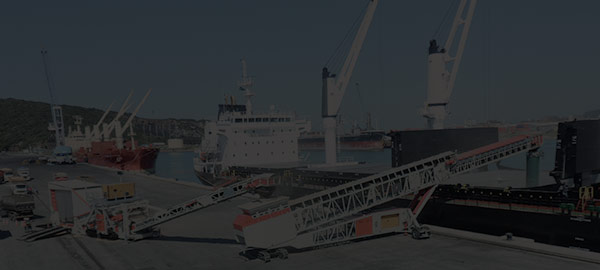
Astec Industries is among the suppliers of high-capacity mobile ship loading systems capable of handling up to 3,000 tph
“We are among the industry leaders in high-throughput ship loading across a range of commodities,” says Booyse.
Discussing operating costs and return on investment, he says cost and operational efficiency are increasingly important considerations when major companies evaluate material-handling equipment. Astec can deliver significant savings by reducing reliance on traditional truck-based hauling.
“Trucking involves the cost of the vehicles, drivers, loading equipment and operators, while truck capacities are relatively limited. Our material-handling systems can move significantly larger volumes, reducing the number of trucks required and the associated costs. They can also create larger stockpiles and load ships directly, eliminating the need to truck material to the vessel and thereby reduce double handling. For larger customers, time is equally important. Higher throughput means stockpiles can be built, material moved and ships loaded faster, ultimately reducing both operating costs and turnaround times.”
The second emerging trend is a preference for mobile equipment over fixed systems to provide versatility in mining and port environments.
“Most of our Telestack equipment is mobile, which is increasingly in demand because of the versatility it offers. At a port, for example, the equipment can be moved between different areas and used for multiple applications, rather than being tied to a fixed location. The same applies to mining operations, where mobile equipment can be relocated as requirements change, allowing customers to work across different areas without the need for permanent infrastructure.”
Thirdly, and in line with the mining industry’s focus on zero harm, there is growing demand for dust control and noise reduction measures.
“Environmental impact is another increasingly important consideration for customers, both at mine sites and at ports. A good example is the system we recently installed in Namibia, where dust and noise control were major concerns. Previously, the operation relied on the conventional truck-and-skip method, which meant trucks were moving continuously around the port to handle the required tonnages. This generated significant noise and made dust control difficult, particularly because the material was being loaded and unloaded in an open environment. Our enclosed ship-loading system addresses these challenges through integrated dust containment and material-handling technology. The equipment can be fully enclosed, with covers fitted over the conveyors to significantly reduce dust emissions. For certain commodities, we can also incorporate water-spray systems for additional dust suppression, although this is not suitable for every material because adding moisture can make some commodities too sticky to handle effectively.”
Beyond dust control, the system operates more quietly than conventional truck-based handling while reducing spillage and clean-up requirements. Port authorities observed a marked reduction in dust emissions and operational noise during the first commercial vessel loading campaign.
Lastly, miners and key industry players are driving demand for technological integration - the ability to integrate equipment into automated mining systems for programmed stockpiling and automatic safety stops.
“On the material-handling side, our equipment is conveyor-based, but these systems can be fully integrated into a customer’s wider mining operation. They incorporate electronic control systems that allow them to communicate with and form part of the overall mine management system. For example, the equipment can be programmed to build specific stockpiles automatically, while the systems can also be linked together to manage start-up sequences across a larger array of equipment. If an issue occurs elsewhere in the mining operation, the equipment can be programmed to stop automatically, helping to improve both safety and operational efficiency.”
The same level of integration applies to ship loading. Astec Industries equipment can be incorporated into the customer’s existing systems to monitor tonnages and optimise the loading process, ensuring that the vessel is loaded efficiently and correctly.
“From a technology perspective, we’re focused on adapting our equipment and systems to meet the specific requirements of each customer, providing greater automation, control and efficiency across the material-handling process.”
Astec Industries product range
Astec provides "pit to port" solutions designed to handle various commodities including coal, manganese, and iron ore.
Mobile link conveyors in the pit
• Mobile conveyors reduce or eliminate the need for truck haulage within the pit.
• It lowers operational costs (fuel, labour, maintenance), reduces emissions, and increases efficiency.
• Up to 3000 tons/hour can be transferred directly from the mining face to secondary crushing, overland conveyors, or truck loading stations.
Stacking in the pit
• Mobile stacking systems create stockpiles within the pit, acting as a buffer for production.
• It enables production control, maximises storage space, and reduces labour needs. Telescopic stacking increases stockpile volume by up to 30% compared to conventional methods.
• Automated radial telescopic stackers can stockpile up to 150 000 m³ from a single position.
Open pit reclaiming
• Mobile reclaiming systems recover material from stockpiles and transfer it to the next processing stage.
• It reduces double handling, minimises haulage distances, and increases plant efficiency.
• Reclaiming rates up to 2500 tons/hour, feeding directly onto existing conveyor systems without civil works.
Pit loadout – rail / truck / barge
• Equipment for safe, efficient loading of material onto rail wagons, trucks, or barges for transport to the port.
• It reduces risk of equipment damage and accidents, controls dust emissions, and lowers maintenance costs.
• Mobile truck unloaders can load rail wagons directly from trucks at 2000 tons/hour, with dust containment features.
Unloading at inland terminal/seaport
• Mobile or fixed systems for unloading trucks, rail wagons, or barges at the port.
• It ensures reliable, controlled logistics flow, reduces double handling, and increases operational flexibility.
• Mobile truck unloaders can handle trucks up to 70 tons at rates up to 1500 tons/hour, with heavy-duty feeders and dust suppression.
Port stacking / reclaiming
• Mobile equipment for stockpiling and reclaiming material in port stockyards and back of port warehousing.
• It offers a cost-effective, flexible alternative to fixed stacker/reclaimer systems, reduces capital and civil costs, and enables rapid expansion or emergency backup.
• Radial telescopic stackers and reclaim hoppers can operate in 'dead' areas of the stockyard and supplement existing systems.
Vessel loading
• Mobile solutions for loading vessels of various sizes directly from stockpiles, trucks, or conveyors.
• It eliminates intermediate handling, reduces costs, increases flexibility, and allows operation in ports with limited infrastructure.
• Mobile shiploader can load up to three hatches of a Handymax vessel from a single feed point, with dust containment and rapid hatch change features.
This article originally published in the October 2026 issue of Modern Mining.